Home of Wasabi Air Racing

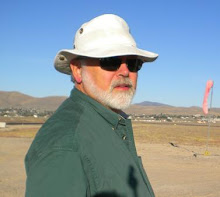
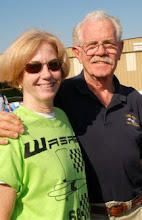
Elliot Seguin and Jenn Whaley's Formula One class air race team based out of Mojave, California. Pylon racing at the National Championship Air Races in Reno Nevada. Eight airplanes racing head to head around telephone poles in the desert. Mojave is the best place on the planet to build and modify a race plane, and Wasabi is lucky to have the best support in the business.

Showing posts with label world speed record. Show all posts

Thursday, December 11, 2014

A weekend at SZP

Got to spend the weekend with Andy and Klaus at Santa Paula.  What a cool airport with so much cool stuff going on.

Check out the ground fog south of Mojave, and the silver dollar that Darryl carried on his 3km run in the F-104, is that cool or what?

Elliot

A photo posted by edseguin (@edseguin) on

Friday, May 4, 2012

The RB-1 "Flying Mackerel"

The Flying Mackerel
The RB-1 before being shipped to France

Everybody has an airplane or airplanes that hit a resonance for them. Some people get really wound up about Piper Cubs; other people see a Q-200 and can’t help but daydream for a few minutes. For some people it may be less severe, for me I have always noticed the Dayton Wright RB-1. Perhaps it’s the picture of twelve guys standing on the wing of the airplane that created questions in my mind as a young engineer. Maybe it’s my unhealthy interest in aircraft with serious forward visibility problems (GeeBee Model Z, Nemesis NXT, Laird Super Solution). For whatever reason I have always noticed the airplane, and a little while ago when Jennifer and I stumbled upon it in the recently renovated “Heroes of the Sky” exhibit in the Henry Ford Museum in Dearborn, Michigan I was pretty excited.


The Dayton Wright RB-1 was debuted at the 1920 James Gordon Bennett Cup Race which was held at the Villesauvage Aerodrome in Etampes, France. The head-designer on the program for Dayton-Wright was Milton C. Baumann and was assisted by Orville Wright, who was a consulting engineer on the program. There were a total of four American designs shipped to France for the race; Glenn Curtiss’ Cactus Kitten and Texas Wildcat, as well as a Verville Scout VCP-1 recently re-engined with a new Packard V-12 and the RB-1. Compared to the other entries, both American and foreign, the RB-1 was a huge technological leap ahead.

The linkages controlling the flap/flaperon position


The RB-1 was a race plane, but more specifically a cantilevered high wing aircraft with retractable main gear and a variable camber wing. The gear was raised by a hand crank on the dash (Long EZ style) which retracted the leading and trailing edge flaps simultaneously with the gear through a system of chains (the process took about 20 seconds). The monocoque fuselage was built of thin strips of wood and doped linen (wood core linen composite construction). The two large side windows had no forward facing compliment, but could be opened slightly to offer the pilot some forward view. The engine was a 250hp Hall Scott water cooled inline six, which was cooled by a large radiator directly behind the propeller. At the time the engine was criticized by other racers for being of WWI vintage and therefore lower power.

Nieuport 29V the winner of the 1920 James Gordon Bennett Cup Race

The wing was 21 feet long and built out of large pieces of balsa, carved to shape and covered with doped linen. The leading and trailing edge flaps were retracted by a series of external linkages (on the top surface of the wing) with the trailing edge flaps doubling as ailerons. For initial flight test, while the retractable landing gear was tested, a conventional strut braced wing was installed. After shipping the airplane to France, the race pilot Howard Rinehart found the directional stability of the airplane wanting and added two vertical surfaces to the tips of the horizontal.

Etampes, France 

September 28th marked the first race of the airplane. On a practice lap in days previous, the RB-1 had reached a speed of 165mph (Howard had commented on the ground that the engine had not been making full power); the crowd expected the airplane to make its design point of 200mph. The race would be three laps of a 100 km course; six aircraft started the race (only two American aircraft, the RB-1 and the Verville). A spectator commented that the RB-1 with her gear retracted resembled a huge flying mackerel. Twenty minutes later Howard landed the RB-1 distraught, a cable had failed causing him to end the race early (sabotage was later suspected). Only two aircraft finished the race, both flying for France. Rudolph Schroeder pulled the Verville out of the race with its new Packard overheating and neither of the Curtiss designs started the race.

Aircraft preparing to race at Villesauvage Aerodrome in Etampes France 

Joseph Sadi-Lecointe won the day in his Nieuport 29V at 168 mph. He would go on to set a world absolute speed record in that airplane twelve days later at 184 mph (he held the record two more times, one of which in the same Nieuport with the canopy faired over). The first major record to be held by an aircraft with a retractable undercarriage was Howard Hughes in the H-1 which set the speed record for land planes on 9-13-35 at 352mph (he could not surpass the Italian floatplane record at 440 mph set 10-23-34). The first absolute speed record to be set with retractable undercarriage was Hans Dieterle in the He-100 at 463mph set 3-30-39 (19 years after the RB-1). The first American aircraft with retractable undercarriage to hold the absolute speed record was Albert Boyd in a P-80 at 623.73 mph set 6-19-47 (27 years after the flights of the RB-1). The RB-1 was not raced again, and somehow survived the test of time to be displayed at the Henry Ford Museum. The airplane is nicely displayed where it can be viewed from many angles and shares the room with Glenn Curtiss’ winning propeller from the first air race at Reims in 1909. Also on display is the Sikorsky VS300A (credited as the first single rotor helicopter).

The RB-1 as displayed at the Henry Ford Museum 

 O'Leary, Michael. “Dayton-Wright RB-1.” Air Classics, Nov 2003 

Davidson, Keith. Record Lists/Racing & Record Aircraft Special Interest Group International Plastic Modellers’ Society. Dec 31, 2006. IPMS.org 

 Author Unknown. James Gordon Cup Races/Society of Air Racing Historians. Aug 26, 2010. AirRace.org

Friday, December 30, 2011

The Last 3km Record; Mojave Roots

by Elliot Seguin
Darryl’s F-104 at Mojave
Full burner at an average speed of 988 mph, 200 feet agl for four passes.  A homebuilt aircraft attempting to topple a record set on a military budget.  Darryl had built his F-104 out of parts he had found painstakingly searching junk yards across the country; this took him 13 years.  All systems unnecessary for the attempt were removed and fuel bags replaced them, giving him 1,050 gallons of Jet A for the attempt (typical standard load is 850 gal).  He landed with 50 gallons remaining; the fuel he had consumed in the 20 minute record setting flight could, if burned at altitude, have powered his jet halfway across the country.  The airplane was assembled in Van Nuys, but was not permitted to fly from there so Darryl trucked it to Mojave for the initial flight test.  When the airplane was destroyed after a gear problem, the wreckage sat here in the Mojave bone yard until the late 80’s when it was finally scrapped.  Al Hansen purchased the airplane after the crash trading a semi truck to Darryl for the wreckage.


Darryl’s 104 during a record setting pass.
The 3km record is historically the absolute speed record in aircraft.  Measured as the average speed of four passes two in each direction over a 3km course the format for the record was developed over many years.  Initially the speed record was more of a VNE record with pilots diving onto the course from greater and greater altitudes.  This was finally controlled by limiting the max altitude that could be reached during an attempt.  The current rules state that the aircraft cannot exceed 100 meters AGL during the run and 500 meters AGL during the turns.  However, as the speed of aircraft has increased since the introduction of the jet age the danger associated with flight at these altitudes has increased substantially.  Between 1953 and 1955 a lull in speed record setting was attributed to this extreme risk.  Fortunately, new timing cameras were developed for flight test of aircraft at high altitude (they were tested here in the Antelope Valley at Edwards).  These cameras were eventually certified by the FAI for speed record setting.  Starting in 1955 the 15/25km closed course record was opened up to all altitudes, this became the new realm of the absolute speed record.  Typically American records were set here at the Mint Canyon Speed Course (an 11.25 mile speed course set up from Palmdale airport south towards LA).  An image conscious military took advantage of this risk reduction and focused on high altitude records until the Navy started on it’s Sageburner program.

Sageburner YF4H-1F (Navy Photo)
The Sageburner program was an effort by the US Navy to probe the extents of the low altitude speed envelope in a modified YF4H-1F.  After 5 years of high altitude speed envelope expansion the 3km record had become very attainable.  The initial F-4 the navy had prepared for the attempt was destroyed after a pitch damper problem resulted in a violent PIO during a low level speed run that broke up the airplane (apparently sending flaming engines several miles down range).  Despite losing the aircraft and pilot (Commander J.L. Felsman) the Navy continued with the program adding a second pilot to observe in the terribly dangerous environment.  The record was finally set on 8-28-61 at a speed of 902 mph by Lt. Hunt Hardesty.  There is a rumor that the very low time engine that Darryl used to set his record was loaned to the effort by the Air Force specifically to embarrass the Navy’s Sageburner effort (not much worse than being beat by “civies”). 
Darryl on the course
Darryl set his record on 10-24-77 at 988 mph.  He had tried in the fall of the year before, but a timing camera problem had disqualified the attempt.  Darryl’s plan was to use the press from the record to build interest in taking the record he really wanted, the absolute altitude record.  The altitude record had been dominated by the Russians for nearly a decade (last held by an American in 1961) and had recently been raised to 123,523 feet on 8-31-77 by Alexandr Fedotov flying a E-266M (a modified Mig-25RB with experimental engines).  Darryl wanted to take this record back and was modifying his 104 for the task.  These modifications included a top secret fuel additive and water injection.  The profile was a speed run out to mach 2.6 at 38,000 feet and then a 3 g pull to a 60 degree climb angle where he would coast to a new altitude record.  He never got the chance to try it.  

The 104 wreckage here at Mojave (Scaled Composites van in Background) (David Lednicer)
 During an otherwise successful test flight for the newly installed water injection system, he did a low pass for the crew here at Mojave.  With twenty minutes of gas remaining threw out his gear to start the approach into Mojave.  He looked down to see that only his nose gear and right main were indicating down and locked.  He flew to Edwards where he set the airplane on the runway to see if the gear felt solid.  Lightly touching the airplane down on the mains at Edwards he found the airplane rolled to the left as he put weight on the gear and the Edwards tower said it looked like it was trying to collapse.  Darryl had no choice but to abandon the airplane.  He climbed up to 10,000 feet over the Edwards bombing range shut down the engine and ejected.  He watched as the airplane flew away from him and then turned back underneath him finally going out of sight below him in the desert.  The airplane was destroyed and Darryl was forced to abandon the project.  The Russian altitude record he was setting out to beat still stands. 

The E-266M (MIG 25M) Absolute altitude record holder (Photo: Paul Nann)
The Lockheed F-104 was in production for 30 years from 1954 through 1983.  They were removed from active USAF service in 1969.  The last operational F-104s were retired from the Italian AMI in 2004.  The aircraft is powered by a J79 afterburning turbo jet engine (the same engine that fired the F-4 Sageburner whose record Darryl toppled).  The aircraft was designed for peak efficiency at mach 1.6, and the airframe was limited to Mach 2.2(over-temperature of aluminum structure).  Early examples featured downward ejection for fear of the t-tail slicing an ejecting pilot in two.  Darryl's 104 wreckage remained in Mojave until the late 80's when it was finally scrapped, a few pieces remain, but most importantly the record still stands, under civilian registration.  What are you working on tonight?


Berliner, Don. Victory Over The Wind. New York: Van Nostrand Reinhold Co. Inc, 1983.

Davidson, Keith. Record Lists/Racing & Record Aircraft Special Interest Group International Plastic Modellers’ Society. Dec 31, 2006. IPMS.org


Fédération Aéronautique Internationale,"FAI Sporting Code” Section 2-Aeroplanes. Lausanne Switzerland, January 2010