Home of Wasabi Air Racing
Elliot Seguin and Jenn Whaley's Formula One class air race team based out of Mojave, California. Pylon racing at the National Championship Air Races in Reno Nevada. Eight airplanes racing head to head around telephone poles in the desert. Mojave is the best place on the planet to build and modify a race plane, and Wasabi is lucky to have the best support in the business.
Showing posts sorted by date for query gt. Sort by relevance Show all posts
Wednesday, December 9, 2015
Tuesday, October 27, 2015
N348LC Test Plan
| N348LC Flt 4, Pilot: Justin Gillen, Chase Pilot: Elliot Seguin (GT-400) |
N348LC Test Plan
7-28-2015
Owner: Larry Channel
Lancair Legacy
Aircraft MSN: L2K-212
Engine: Cont IO-550
Engine MSN: IC-6584
Propeller: Hartzell
Prop MSN: JN286B
Location for testing: Apple Valley Airport, Mojave Air and Space Port
Designated Airworthiness Representative: Carl Gerker
Risk Statement:
Flight test is risky and this aircraft is complex and expensive. While Wasabi Flight Test plans a deliberate, responsible, and risk adverse approach to testing the aircraft; there are inherent risks to the aircraft that cannot be avoided. We suggest hull insurance coverage for the value of the aircraft during the phase one flight test. Wasabi Flight Test is not to be held responsible for damage to the aircraft during phase one flight test.
Project Summary:
The intent is to perform the testing required to complete the phase one flight test as directed by paragraphs 3, 4, 10, and 15 from the representative operating limitations as described AC 90-89A and outlined in the following test plan summary. This will include 40 hours of flight test to be performed by Wasabi Flight Test pilots. At the end of the test phase, a report will be generated for the owner describing to what flight conditions the airplane has been demonstrated and the characteristics or phenomena observed at those conditions. Wasabi Flight Test pilots are neither check-out pilots nor CFIs, and as such make no assertions in transitioning the owner into said aircraft upon completion of phase one operations.
Aircraft overview:
The Lancair Legacy is a two seat, low wing, aircraft with 40° flaps, tricycle retractable landing gear and a low cruciform tail. The stock airframe is powered by a continental IO-550. This particular aircraft has never flown before.
Test Plan Summary:
AC 90-89A will be used as a reference for the flight test program. Based on those recommendations the test plan is listed below. This is a guide the actual order of testing will depend on how everything comes together.
Hours 1-3
Per Chapter 3, Section 4 of AC 90-89, the initial flights, hours 1-4, have two objectives: 1. confirm engine reliability, and 2. confirm basic flight characteristics. These initial flights will be done at power settings to facilitate new engine break in, with flight times less than 45 minutes. Typically these flights are spent diagnosing cooling problems. Initially the envelope will be cleared from VREF to VA (90 KIAS to 170 KIAS, or to 1.3x VS) and 0.5 G to 2.5 G. This envelope will provide ample room to evaluate gross handling issues without stressing the engine early in the break-in process. The envelope will be cleared using 3 axis stick wraps in 5 knot increments. The flap and gear systems will also be validated during this initial phase of testing. Inspections between flights will be significant with full cowl removal after every flight.
Hours 4-10
Per Chapter 4, Section 3 of AC 90-89, these flights will be used to build on the data established by the first three hours and start expanding the flight test envelope. This time is also used to begin operational type testing and validation. In particular, climbs and descents will be used to check the engine reliability and installation effects in these demanding phases of flight. Installation error of the airspeed indicator will also be checked. Airspeed calibration checks will be done using available methods.
Hours 11-20
Per Chapter 5, Section 2 of AC 90-89, upon successful engine break-in, testing will further expand the envelope while validating the predicted operational aspects of the airplane. With the airspeed indicator calibrated, this time is used to validate the published VBG, VX, and, VY. Testing is performed referencing 23.71 for glide testing, and 23.65 for climb testing. During this phase, the airplane will be stalled for the first time. Starting with clean configuration power-off stalls and advancing to partial-power, landing configuration stalls, and finally to turning, and accelerated stalls. Stall testing will be done using 23.49, 23.201, 23.203, and 23.207 as guidance.
Hours 21-35
As per Chapter 5, Section 3 of AC 90-89, this phase of testing will be used to validate the stability and control aspects of the aircraft, namely static and dynamic stability in all three axis, using 23.145, 23.147, and 23.155 as guidance. As discussed in the “Maneuvers to be cleared” section below, testing in this phase will clear the aerobatic maneuvers required, using 23.151 as guidance.
Hours 36-40
This phase of testing will re-check the previously flown points at the extremes of the C.G. envelope and dive test the airplane to VNE or VD.
Speed envelope to be cleared:
Paragraph 4 describes “normal range of speeds”. This will be from VS0 (stall speed landing configuration) to VD. Unless deemed necessary, it is assumed that the published VNE of 263 KIAS will be acceptable as a max speed limit for this aircraft. Because of the natural aspiration of this aircraft, the service ceiling will be reported. This testing will reference 23.1527.
Load factor to be cleared:
The published maximum load factor for the airplane is +4.4. The aircraft will be tested to this point at the published gross weight of 2,200 lbs. If the weight of the aircraft is too heavy to allow testing at this weight, the load factor will be scaled such that the wing sees the same peak bending and the load factor limit will be reduced. The aircraft will not be taken to a negative load factor below zero. This testing will reference 23.155.
Maneuvers to be cleared:
According to paragraph (15) all aerobatic maneuvers to be flown must be demonstrated during phase
one. This testing will reference 23.203.
Cruise testing:
In order to provide a baseline for later modifications, a “cruise snap shot” will be documented. This will provide a comparison point for later in the life of the airplane. This snap shot will include: W&B, power setting, all CHTs, all EGTs, fuel flow, KIAS, KTAS, OAT, and pressure altitude.
Speeds to be determined:
According to paragraph 4 below, VS0, VX, and VY need to be determined, along with VS and VBG. VFE, VA, VLO, and VLE will be demonstrated. This testing will reference 23.201, and 23.203.
Weight and C.G.:
The published weight and CG envelope for the aircraft is 2200 lbs. and 10% to 25% MAC; this entire envelope will be demonstrated with handling checks and stall evaluations at each CG location. These W&B configurations are to be given specific attention. This testing will reference 23.23, 23.201, and 23.203.
1. Heavy-Aft. Full Mains, Full Aux, Two 200 lbs. Crew, 75 lbs. baggage.
2. Nominal. Full Mains, Two 200 lbs. crew
3. Solo Aft. Full Mains, Full Aux, Solo 200 lbs., 75 lbs. baggage
4. Race. Full Mains, Solo 200 lbs. crew
Representative operating limitations:
(3) This aircraft must be operated for at least (40) forty hours in the assigned geographic area.
(4) All test flights, at a minimum, must be conducted under day VFR only. Guidance concerning the scope and detail of test flights can be found in AC 90-89. Following satisfactory completion of the required number of flight hours in the flight test area, the pilot must certify in the records that the aircraft has been shown to comply with CFR 91.319(b). Compliance with 14 CFR 91.319(b) must be recorded in the aircraft records with the following, or a similarly worded statement: “I certify that the prescribed flight test hours have been completed and the aircraft is controllable throughout it’s normal range of speeds and throughout all maneuvers to be executed, has no hazardous operating characteristics or design features, and is safe for operation. The following aircraft operating data has been demonstrated during the flight testing: Speed VS0____, VX____, and VY____, and the weight _____ and CG location ______ at which they were obtained.”
(10) During flight testing phase, no person may be carried in this aircraft during flight unless that person is essential to the purpose of the flight.
(15) This aircraft may conduct aerobatic flight in accordance with the provisions of 14 CFR 91.303.
Aerobatics must not be attempted until sufficient flight experience has been gained to establish that the aircraft is satisfactorily controllable and in compliance with 14 CFR 91.319(b). This aircraft may only conduct these maneuvers that have been satisfactorily accomplished during the flight testing and recorded in the aircraft logbook and maintenance records by use of the following, or a similarly worded, statement: “I certify that the following aerobatic maneuvers have been test flown and that the aircraft is controllable throughout the maneuvers’ normal range of speeds, and is safe for operation. The flight tested aerobatic maneuvers are ___________, __________, ___________, ___________, ___________, and ___________.
Saturday, July 18, 2015
The GT400's new livery!!
Hey Guys,
I wanted to thank Dan Kreigh, Kelsey Moran, and Whitney Brown for all the help getting the GT looking sharp for it's Oshkosh debut.
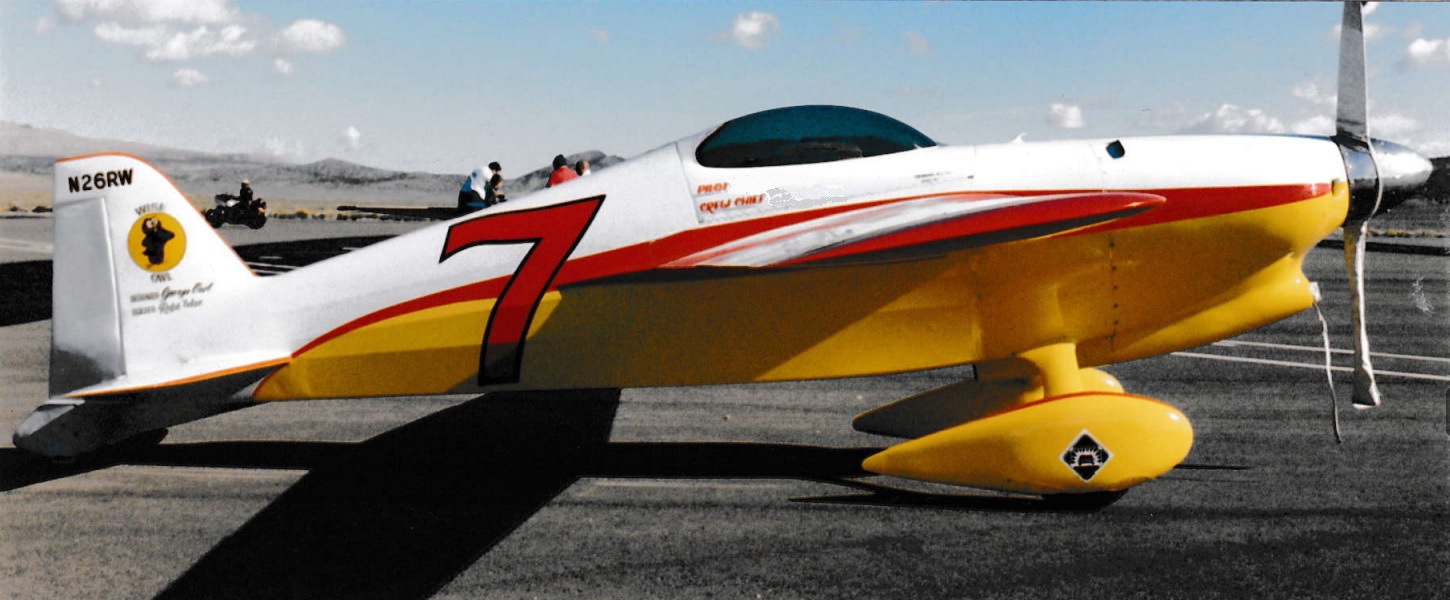
The airplane will be on display in the Reno Air Racing area on Boeing Plaza so we wanted to bring out it's racing roots. We used some old photos of Ralph's Owl Racer the "Wise Owl" to replicate his old race number on the GT400. I am super stoked to get to help tell Ralph's stories to the next generation of performance aircraft enthusiasts.
See you in Wisconsin!!
Elliot and Jenn

I wanted to thank Dan Kreigh, Kelsey Moran, and Whitney Brown for all the help getting the GT looking sharp for it's Oshkosh debut.
The airplane will be on display in the Reno Air Racing area on Boeing Plaza so we wanted to bring out it's racing roots. We used some old photos of Ralph's Owl Racer the "Wise Owl" to replicate his old race number on the GT400. I am super stoked to get to help tell Ralph's stories to the next generation of performance aircraft enthusiasts.
See you in Wisconsin!!
Elliot and Jenn

Friday, July 3, 2015
Mower Power to the People
Last week Wasabi's airframe specialist Ken Baker got stranded for weather in Texas, as a result he had to leave his Piper Arrow behind and airline back to Mojave to make it to Scaled for work Monday. Rescuing the stranded Baker was the perfect opportunity to get some more cross country data on the GT-400 and check out an aviation legend in the flesh.
The DA-11 has a cult following at Scaled Composites, and I have been trying to get to Texas to see it for a while. Below are some of the pictures from the trip. Such a freaking cool airplane.
Monday, June 15, 2015
Tomorrows record attempt
Hey Guys,
Tomorrow Justin Gillen, Jenn Whaley, Rick Poe and I are leaving for Stead to attend the 2015 Pylon Racing Seminar (rookie school). We are flying two bad ass airplanes up (Tangotimemachine and the GT400), and attempting to set two records while we are at it (point to point, MHV to RTS, C1b/C1c).
I can't decide what I am more pumped about, that two good friends who have helped Jenn and I make Wasabi what it is are going to get their race tickets, or that we have an opportunity to get Ralph Wise and his GT-400 in the record books. Either way it is going to be awesome and I am pumped.
Attached are some pictures of some of the preparation building up to these attempts.
You can follow along on tomorrows flight on our spot page (link). We plan to launch after lunch (1:30 PST).
Wish us luck!!
Airplanes are cool,
Elliot
Monday, February 2, 2015
Sundays With Ralph Episode 5
Hey Guys,
Below is the report for FLT005 in the GT-400 "Snort".
It was a great flight. Mojave Experimental Flyin is coming up and everybody is talking about records, so we used it as an excuse to get some performance data on Snort. The result was 1.87 ft^2 effective flat plate area.
We also used this opportunity to further qualify an approach we use on Wasabi. So by measuring manifold pressure (MAP) and the speed of the engine (RPM) we know the horsepower that a stock 520 would make in that configuration. The issue is we don't know the efficiency of the propeller, and we don't know how strong the engine is. The solution, as Andy would say is "more data!".
In order to get more data points to backup the assumption that Continental is accurate with their power estimates we use the dive method (see Hoot's report link). If you know the weight of the airplane, you can derive the thrust given by a dive. You already know how much power Continental thinks you should be making. So by summing the two you know how much HP it took to go that fast.
Example: The GT-400 weighed roughly 2400 pounds, so with a 500 FPM descent you are getting energy from gravity at a rate of 36 HP. Add 36 HP to the 165 HP the engine was making and you get 201 HP. Experimentally we found this correlated to a indicated airspeed of 250 MPH. 250 MPH correlates to a dynamic pressure of about 160 pounds per square foot. 206 HP at 250 MPH correlates to 302 lbs of thrust. So 302 divided by 160 is 1.88 square feet of equivalent drag.
This is a little harder with Snort because the airplane is naturally aspirated and we try to keep the flights to about an hour. Without automatic boost regulation the MAP (and therefore power) changes with altitude, and at -2000 feet per minute the altitude is changing pretty fast. There are two options for this you can time your flying just right so that you pass through a particular altitude at the moment you are on condition. Or you can take note of your altitude and MAP when you get stabilized and look up the HP for each pass individually. We did the latter.
The plot below is the summary of the data. The cluster is pretty tight, which almost makes me believe the data!!
Airplanes are cool,
Elliot
3 things worth noting:
1. We made no attempt to compensate for the loss of thrust from the propeller. Typically assumed to be 90% efficient, this makes our findings somewhat conservative.
2. The reason this is a more difficult test with Wasabi is the Continental reference material does not typically go to the engine RPM that we are running, which requires making assumptions.
3. Below is a picture of the panel on Snort. Note on the Manifold pressure gauge (top right) that ~1/8" = 1 INHG. This resolution is a little coarser than I would like for this kind of testing.
Monday, January 26, 2015
Sundays with Ralph episode 4
Hey Guys,
Ralph and I had a great time on Sunday, we are trying out different arrivals to the airport to get ready to land at a different airport for the first time. We are also still investigating the "poor centering" experienced on flight two. We have not been able to replicate it yet.
Check out this great GT-400 detail below. This is the spring loaded gap seal on the bottom of the wing. Such a cool airplane!!
Airplanes are cool,
Elliot
| Spring loaded gap seal on the flap of the GT-400 |
Wednesday, January 21, 2015
Sundays with Ralph Episode 2+3
Hey Guys,
Below are the test reports from flight 2 and 3 with the legendary Ralph Wise in the GT-400. There are good days and there are really good days.
The GT is a complicated and eccentric one off aircraft that has until very recently only ever been operated by one man, Ralph. The result has been a fascinating study of Ralph, of Navy procedures, of the airplane, and of myself.
I hope these reports are interesting, as the flying certainly was.
Airplanes are cool,
Elliot
Labels:
Experimental Aircraft,
Flight Test,
GT Aero,
GT-400,
N122RW,
Ralph Wise
Friday, December 26, 2014
GT-400 Flight Report
Hey Guys
Below is the report for my flight in the GT-400. The flight focused on getting familiar with the airplanes systems, and the report reflects that. We plan to do more quantitative performance and handling testing in the coming months.
Ralph Wise is a long time airplane designer and builder with nine airplanes to his credit. During Vietnam he was a Marine Fighter Pilot flying A-4s and F-4s. He started his first race plane project in 1971 when he was still active in the marines, building the modified Owl OR-65 (Race 22) in the living room of the house he was renting off base in Yuma. He raced the airplane and eventually built another Owl, this one a OR-68, race 7, that he named Wise Owl.
While competing in the CAFE races at Oshkosh in 1980 with the Wise Owl Ralph lost a propeller blade on his aluminum Sensenich propeller just outside of Fon Du Lac Wisconsin and ended up landing in a farmers driveway. This prompted a development program by Ralph and George Owl to find an alternative to the troublesome aluminum propellers. George designed and Ralph built and tested wood core propellers that eventually took Ralph to a top qualifying speed in race 7. When George died Ralph continued the work tweaking the design of the propeller and testing it on his racer.
Ralph's other projects included a Sea Hawker Amphibian, a Yak-11, and a personal favorite the RW-500 unlimited bid. The RW-500 was a Owl sized Unlimited racer that Ralph planned to power with an automotive V-8, without a gearbox. Because of Ralph's experience with carving propellers, it made sense to carve the propeller for the RW-500. The fact that the Chevy needed five thousand RPM to make the required power is less of a leap when you consider Ralph's props were already turning four thousand on the IF1 course. And the idea of a hand built prop turning 5k is so freaking awesome, I don't have words. The airplane was also briefly configured with a 540 Lycoming.
Once Ralph saw that the Rare Bear set the world propeller speed record of 528 MPH in 1989, he started to second guess the program. This re-baselining of the program ended up with a completely new airplane, the GT-400. The GT is a two seat tandem touring aircraft with a composite fuselage and an aluminum wing, it is powered by a Continental 520. Ralph designed and built the airplane over 12 years, culminating in a first flight in 2004.
Below is the report for my flight in the GT-400. The flight focused on getting familiar with the airplanes systems, and the report reflects that. We plan to do more quantitative performance and handling testing in the coming months.
Airplanes are cool,
Elliot
Ralph Wise is a long time airplane designer and builder with nine airplanes to his credit. During Vietnam he was a Marine Fighter Pilot flying A-4s and F-4s. He started his first race plane project in 1971 when he was still active in the marines, building the modified Owl OR-65 (Race 22) in the living room of the house he was renting off base in Yuma. He raced the airplane and eventually built another Owl, this one a OR-68, race 7, that he named Wise Owl.
![]() |
| Ralph's OR-65 Race 22 |
![]() |
| Formula racers, Aloha in #1, Race 5 Cassutt in #2, Ralph in Wise Owl in #3, and the Wagner now Miss U (link) |
![]() |
| Ralph and the RW-500 in 1986 by Dan at AAFO (link) |
![]() |
| The RW-500 on display at the Milestones of Flight Museum, Photo David Lednicer (link) |
![]() |
| The GT-400 at the Mojave Experimental Flyin (link) |
Labels:
CAFE Race,
Experimental Aircraft,
Flight Test,
George Owl,
GT-400,
OR-65,
OR-68,
Ralph Wise,
Snort,
Test Report,
Wise Owl
Tuesday, December 23, 2014
Flying with Ralph
Ralph Wise is a legend, and I have admired his GT-400 since I first saw it when I met Ralph in 2005. the GT is the most recent of the 9 airplanes that Ralph has built, most of which being race planes. Ralph is a staple at the Mojave airport, we can always count on him to help with whatever pickle we get ourselves into with Wasabi or anything else on the airport. Last weekend I got the chance to fly the GT-400 from the front seat. A fantastic flying airplane. Report to follow.
Labels:
Experimental Aircraft,
Flight Test,
GT Aero,
GT-400,
Mojave Airport,
Ralph Wise,
Snort
Tuesday, June 30, 2009
Subscribe to:
Posts (Atom)


Need a sticker, send an